
Parts of the Antarctic Ice Sheet stick to the bed most of the time but lurch forward once or twice per day, synchronized by the ocean tides. A new paper by Zachary Katz, a PhD student at the Colorado School of Mines, and co-authored by Mines advisor Matt Siegfried and ESR’s Laurie Padman, was just published in JGR Earth Surface, describing this slip-event timing and ice velocity variations on ice streams, broad glaciers that transport ice from the Ice Sheet to the ocean.
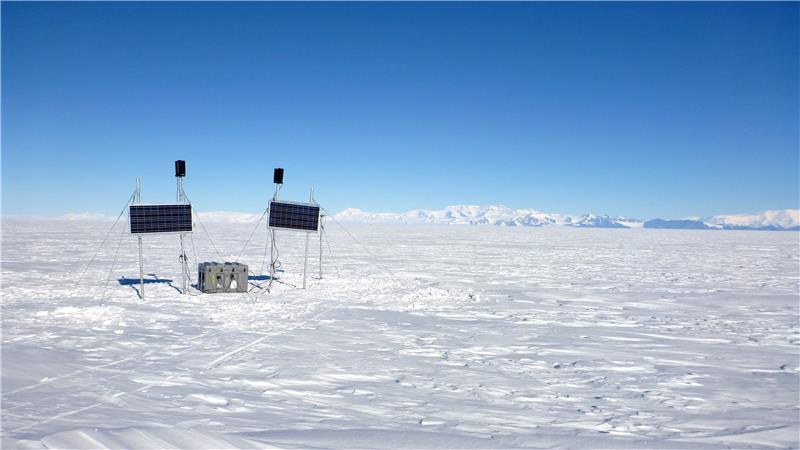
The study combined 11 years of GNSS data from the Whillans Ice Plain near Ross Ice Shelf to detect lurches in its motion, and then correlated this with tidal cycles. The authors conclude that variability of ocean tides (caused by long-period tidal cycles and changes in ice shelf thickness) will modify rates of ice loss from the Ice Sheet. Therefore, accounting for long-period tidal variability is important when analyzing ice motion and mass loss from the ice sheet.
Read the open access paper:
Citation:
Katz, Z. S., Siegfried, M. R., & Padman, L. (2026). Slip-event timing and ice velocity vary at long-period ocean tidal frequencies at Whillans Ice Plain, West Antarctica. Journal of Geophysical Research: Earth Surface, 131, e2025JF008770. https://doi.org/10.1029/2025JF008770